Vũ Thanh Thuỷ
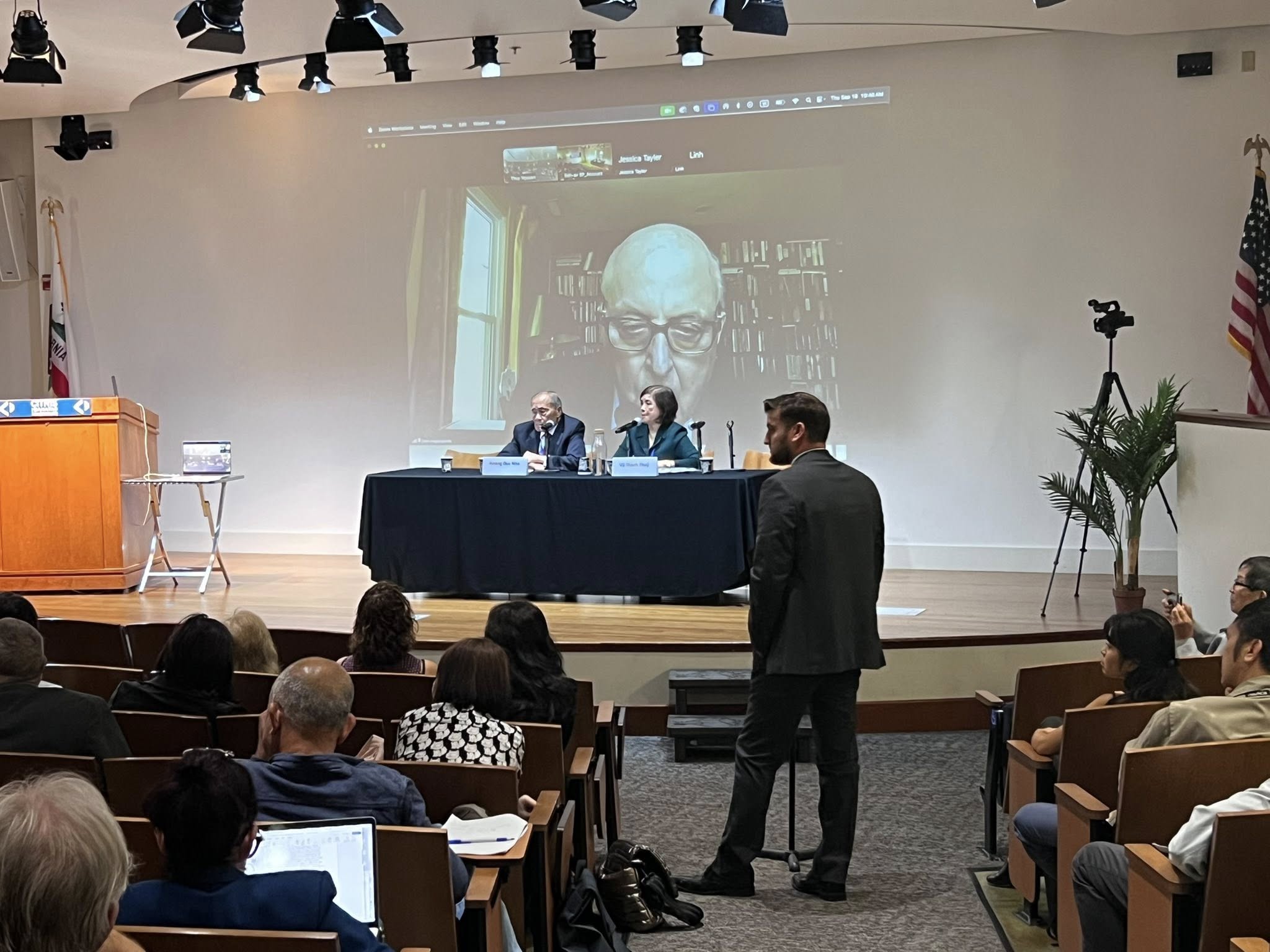
U.S.-Vietnam Review: This speech by Vũ Thanh Thuỷ, Silver Star-awarded war correspondent in the Republic of Vietnam, was delivered at the International Symposium on “The Challenges of Peace: US-Vietnam Relations since 1975” held at the University of California, Berkeley on September 18th to 19th, 2025.
Memory is NOT Negotiable
Good morning,
Thank you for having me here today. I am grateful to my co-panelist, Mr. Bùi Kiến Thành, Ambassador John Negroponte, and Mr. Hoàng Đức Nhã for answering all the questions raised, so now I could just share my thoughts on the past and the present in hope to shape the future.
When I was asked to participate in this conversation about the US and Vietnam relationship before and after 1975, I was reluctant.
Would whatever I have to say make any difference in this seemed to be a done deal policy between the two governments?
Would my presence here at this reconciliation dialog make my diaspora community feel that I have forgiven and forgotten what the Communist regime had done to me, to my family, and to the millions of my South Vietnamese fellowmen?
I was reluctant to come.
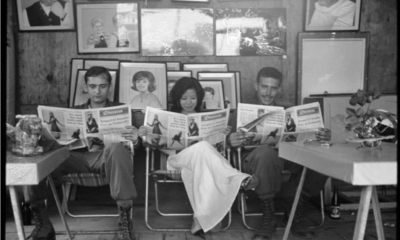
But then I remember my colleagues and friends, war correspondents, Vietnamese and Americans, French and Canadians, who died at the frontlines trying to share the truthful news with the world before 1975. I remember hundreds of thousand Vietnamese boat people perished at sea fleeing the communist regime in search of freedom. The freedom to live with just basic human rights.
50 years have passed, but why can I NOT forget? Because I survived when many did not. Because it’s a duty to speak up for the ones who no longer had a voice.
I remember my vow to share the truth as a South Vietnamese journalist, to tell the world what REALLY happened in my country, under the communist regime who mistreated us 50 years ago and now still suppresses anyone speaking the truth about communism.
I do not recount this for sympathy or out of bitterness, but for context. Because reconciliation, if it is to be meaningful and effective, must begin with truth.
Because History is not merely a record of events—it is a mirror of choices, ideologies, and consequences. And when we speak of the US-Vietnam relation and the reconciliation between overseas Vietnamese and the current government of Vietnam, we must begin NOT with sentiment, but with historical clarity.
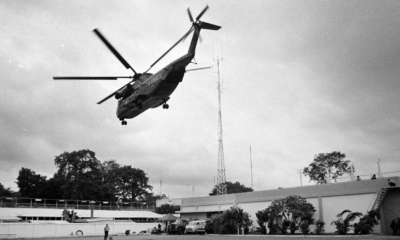
In 1975, the fall of Saigon marked not only the end of a war, but the beginning of a profound rupture in Vietnamese society. Families were divided. Institutions dismantled. Freedoms extinguished. What followed was not peace, but reeducation camps, mass exodus, and the silencing of dissents.
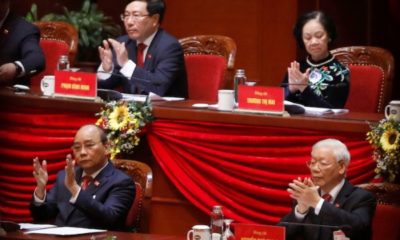
The communist regime that emerged from that moment did not simply govern—it imposed a worldview. It redefined patriotism as obedience, and dissent as betrayal. It rewrote history to serve power, not truth. And it demanded that we forget.
Today, we are asked to reconnect. To reconcile. To return. But reconciliation cannot be built on selective memory. It cannot ignore the suffering of those who fled, nor the continued repression of those who remain. The Vietnamese government has yet to recognize the full scope of its actions—let alone offer restitution or genuine reform.
Therefore, I am skeptical of the Vietnam government call for Reconciliation.
Skepticism, in this context, is the refusal to accept a narrative that erases pain in the name of unity. It is the insistence that reconciliation must be earned—not declared. I do not oppose dialogue. I oppose the erasure of history in the name of diplomacy. I oppose the idea that we must set aside principle for the sake of appearances.
Reconnection must be rooted in moral clarity, not political convenience. Dialogue must be honest. It must confront the ideological foundations of the regime—foundations that remain intact. The apparatus of control, the intolerance of pluralism, the suppression of civil society—these are not relics of the past. They are current realities in Vietnam.
To reconcile is to rebuild trust. But trust requires truth. And truth, to me, is that memory is NOT negotiable. We must face all the historical facts. History CAN NOT be altered. And any future worth building must begin with moral clarity.
Reconciliation must be more than an appearance. Therefore, we cannot move forward until we have first looked backward and confronted the full measure and consequences of our past.
For that, I would like to close with a few words to the younger generation: —you inherit—not only our language and culture, but also our unfinished questions. Ask them. Pursue them. And do not be afraid to demand truthful answers.
Your role is not to forget, but to remember the past. And in remembering, we help shape a future that honors the dignity of all Vietnamese—those who stayed, those who fled, and those still waiting to be heard.
Thank you!